Home › Articles › Apex Neural Rendering put to the test: for Digital Foundry the open-source frame generation comes close to DLSS, but with ghosting and flaws
Apex Neural Rendering put to the test: for Digital Foundry the open-source frame generation comes close to DLSS, but with ghosting and flaws
In tests on an RTX 5070 Ti, Apex Compute's free alternative, developed by a single engineer, was faster than DLSS in Spider-Man Remastered and slower in Cyberpunk 2077 and Crimson Desert. YouTuber Ancient Gameplays was more critical.
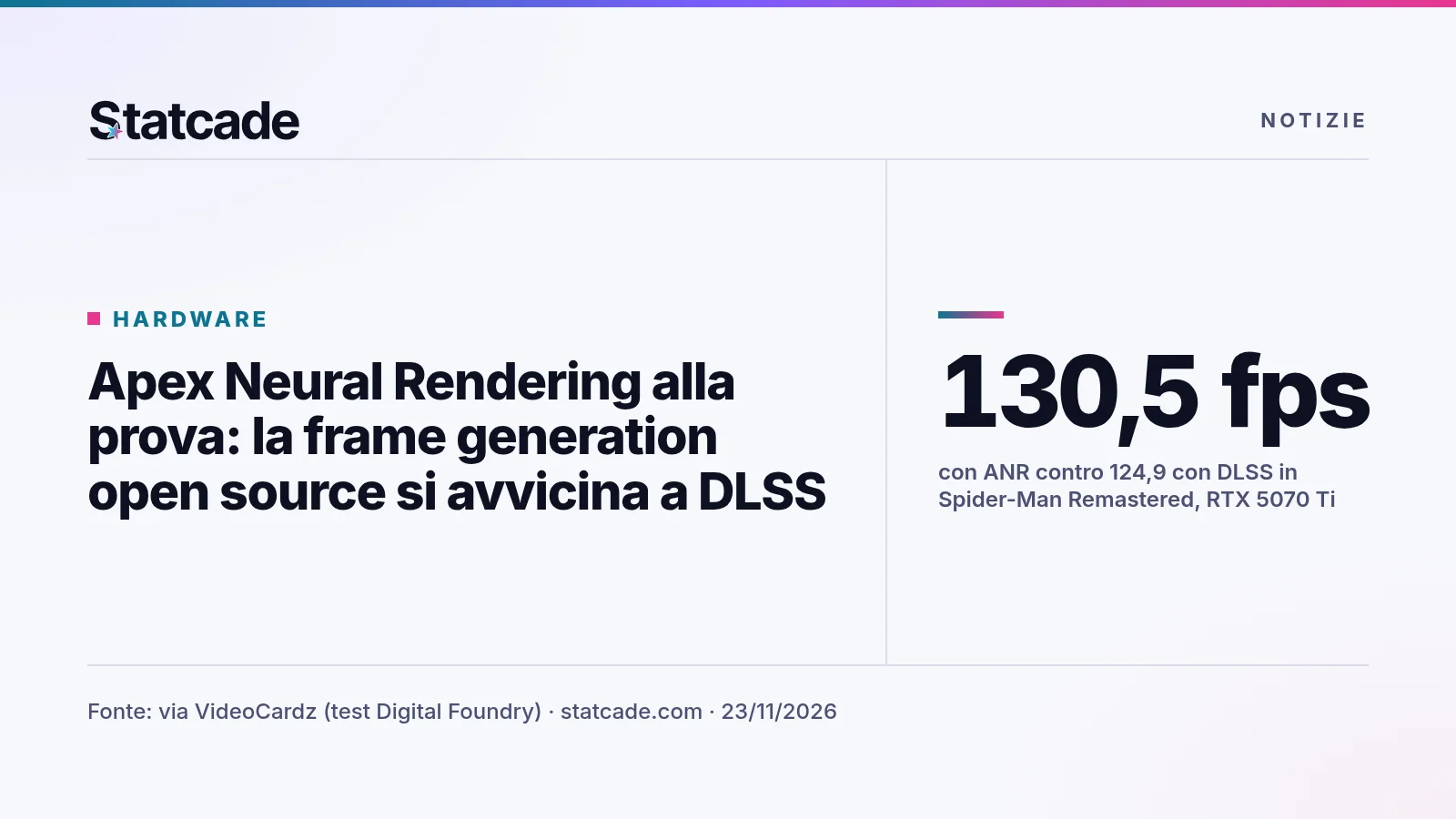
The first independent tests of Apex Neural Rendering (ANR) are in: the open-source alternative to DLSS developed by Apex Compute. For now only frame generation is available in beta; it uses compute shaders and runs on GeForce GTX 16 and RTX, Radeon RX 5000 and later, and Intel Arc.
Digital Foundry compared it with DLSS on a GeForce RTX 5070 Ti: in Spider-Man Remastered ANR ran at 130.5 frames per second against 124.9, while DLSS was about 10% faster in Cyberpunk 2077 and, narrowly, in Crimson Desert (203 against 195.7). Latency was close, image quality uneven: fewer artefacts in fast motion, but problems with ghosting, subtitles and camera cuts. “For a solo developer to achieve comparable results is truly remarkable”, was the verdict, without however recommending dropping DLSS. Ancient Gameplays was harsher, reporting artefacts, uneven frame pacing and a non-interpolated interface.
Sources: VideoCardz (with tests by Digital Foundry and Ancient Gameplays). Text by Statcade.