Home › Articles › BitLocker and Windows Hello PINs: With Physical Access to the PC, the Attempt Lockout Can Be Bypassed, Thanks to Flaws in Winbond Chips and AMD Firmware
BitLocker and Windows Hello PINs: With Physical Access to the PC, the Attempt Lockout Can Be Bypassed, Thanks to Flaws in Winbond Chips and AMD Firmware
Researchers at TU Berlin show how to reset the TPM's failed-attempt counter on many x86 PCs. In the worst case, a six-digit BitLocker PIN can be found in 20 days instead of 19 years.
Six researchers at the Technische Universität Berlin have found a way to bypass the lockout after failed attempts that protects Windows Hello and BitLocker PINs. The attack requires physical access to the computer. The study was presented at ACM CCS '26.
On x86 PCs with a firmware TPM, the attempt counter is stored in the motherboard's SPI flash memory. The researchers found two flaws. With a voltage glitch, Winbond chips reveal the key that protects the counter. AMD's firmware, meanwhile, does not check that the counter actually increases.
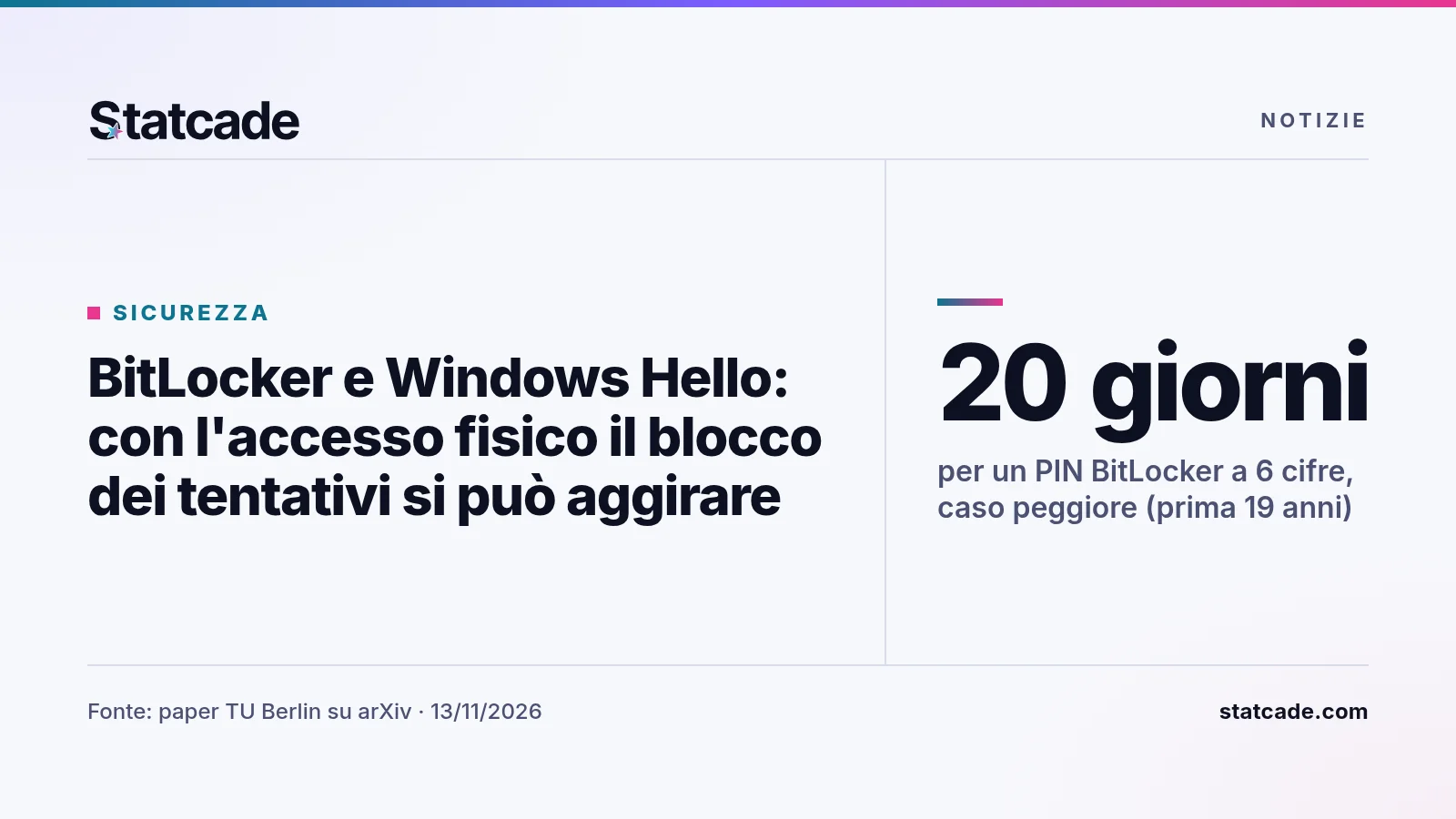
In the worst case, a four-digit Windows Hello PIN is found in about 40 hours instead of 69 days. For a six-digit BitLocker PIN, the time drops from 19 years to 20 days. According to Tom's Hardware, PCs with Winbond chips cannot be fixed without new hardware.
Sources: TU Berlin (paper on arXiv); Tom's Hardware; WindowsForum. Text by Statcade.