Home › Articles › CachyOS November release supports Easy Anti-Cheat Linux v2, with a separate signed kernel using Secure Boot and TPM 2.0 for protected games
CachyOS November release supports Easy Anti-Cheat Linux v2, with a separate signed kernel using Secure Boot and TPM 2.0 for protected games
One of the most used Linux distributions for gaming introduces a dedicated kernel, booted only when needed, that meets the requirements of the new version of Epic's anti-cheat. The same release brings a recovery environment and a new package installer.
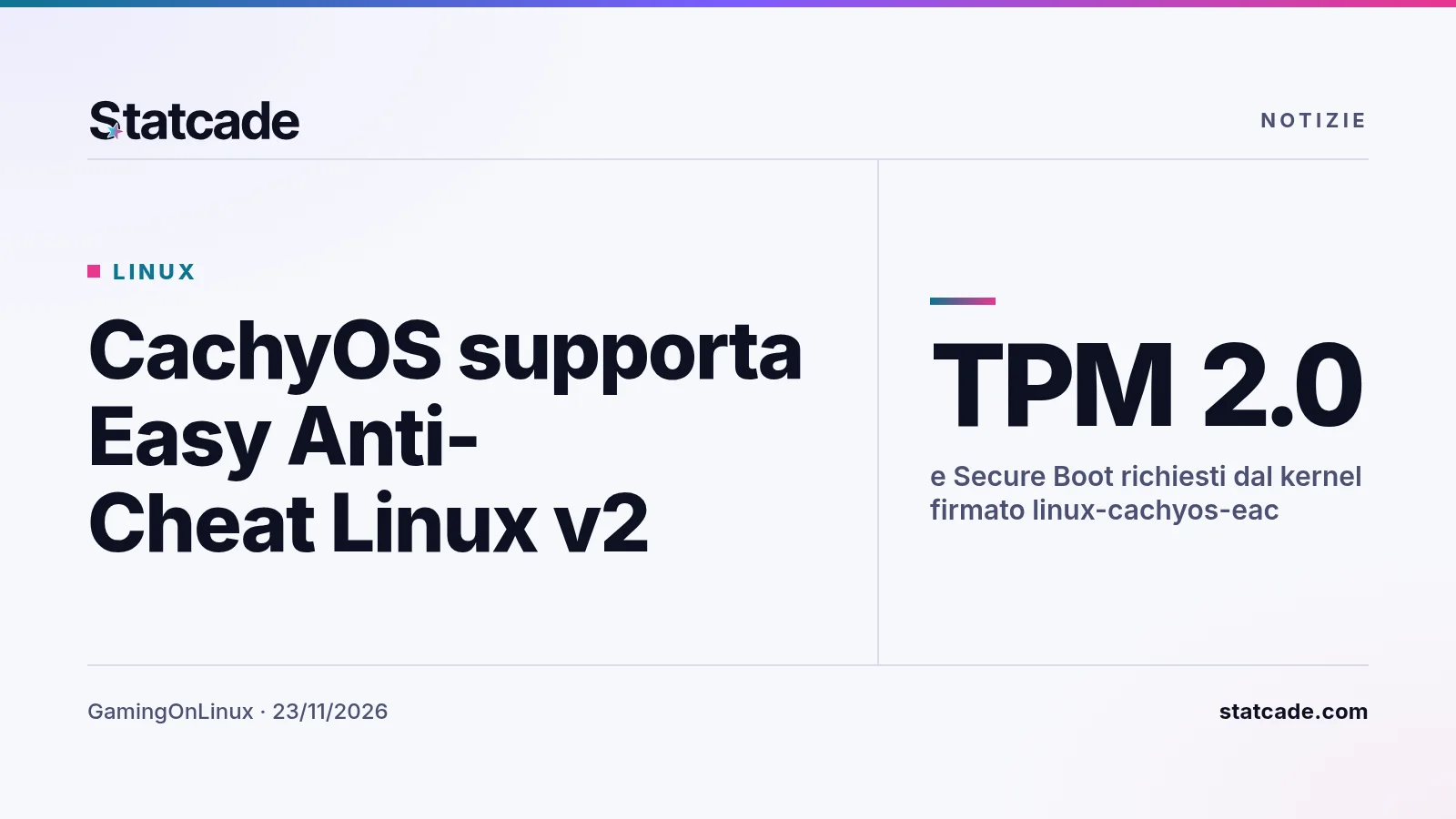
CachyOS, an Arch-based Linux distribution very popular with PC gamers, has published its November 2026 release with support for Easy Anti-Cheat Linux v2, the new version of Epic Games' anti-cheat. The step comes as Epic brings the preview of its Epic Games Launcher to Linux.
According to the CachyOS team, EAC Linux v2 only lets games start if it can verify how the system was booted: it requires Secure Boot with a kernel signed by a key Epic trusts, a TPM 2.0 chip, IOMMU enabled and a kernel in "lockdown" mode that only loads signed modules. For this reason the distribution provides a dedicated kernel, linux-cachyos-eac, with a systemd-boot signed with the same key. The EAC kernel has a separate boot entry and the normal ones remain: you only use it when you want to play a title that uses EAC. The eac-setup script configures systemd-boot, Limine and rEFInd (GRUB experimentally) and eac-status checks the result. Since DKMS modules do not work with this kernel, the NVIDIA drivers, ZFS and the r8125 network module are distributed in dedicated packages.
The release also brings a recovery environment for rolling back to Btrfs snapshots without a USB stick, version 2.0.0 of the package installer with optional support for AUR, Flatpak and AppImage, and updates the system to Linux 7.3.5, Mesa 26.3.1 and NVIDIA driver 620.73.04. For GamingOnLinux the choice of an optional kernel is "sensible" and could serve as a model for other distributions.
Sources: GamingOnLinux; Phoronix. Text by Statcade.