
Home › Articles › SC26: AMD bets on native FP64 compute in Instinct MI430X and criticises the emulation chosen by NVIDIA
SC26: AMD bets on native FP64 compute in Instinct MI430X and criticises the emulation chosen by NVIDIA
At Supercomputing 2026 in Chicago, AMD argues that emulating double precision with Ozaki schemes fits less than 10% of HPC workloads and can triple memory use.
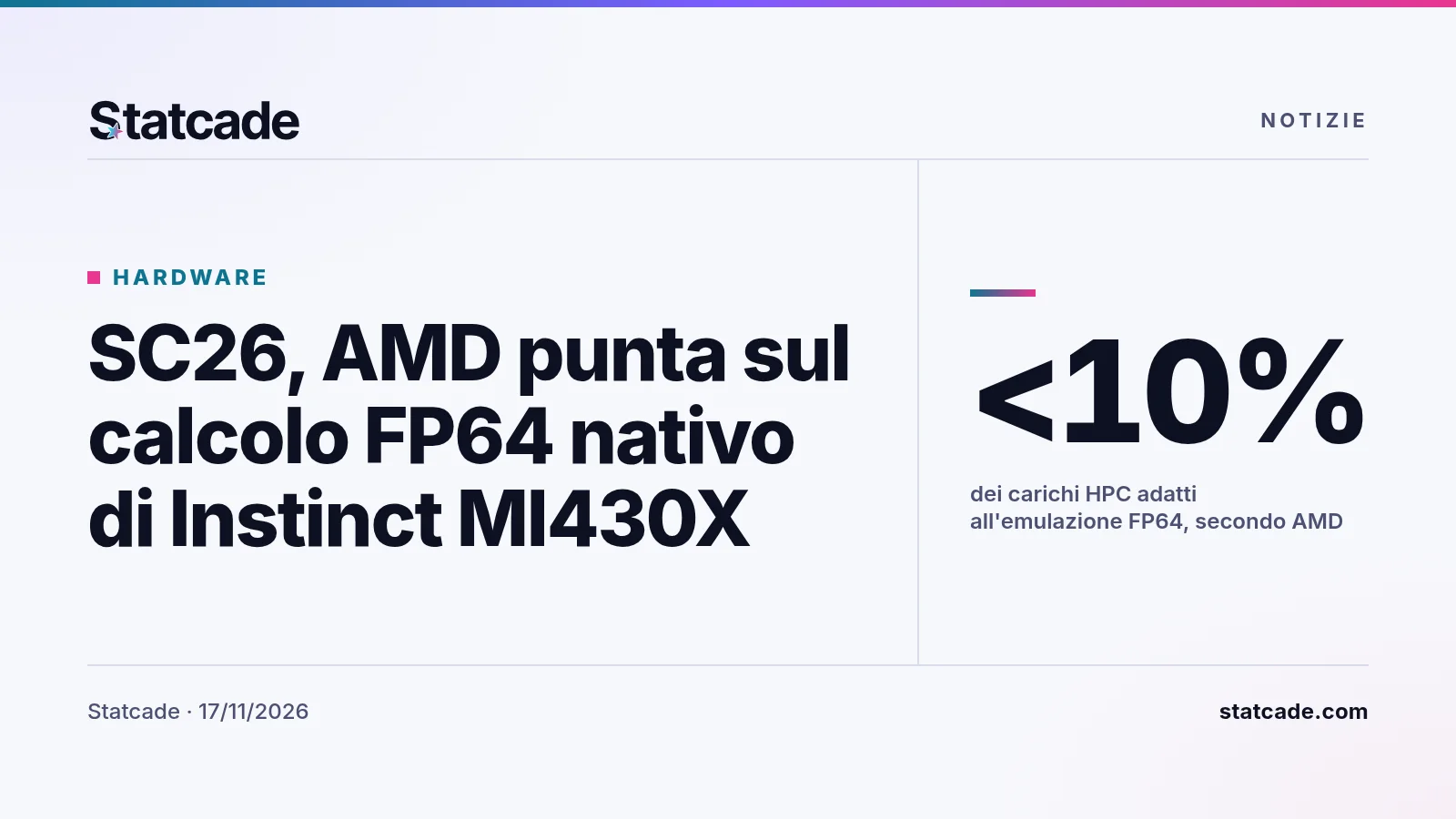
While NVIDIA has reduced the space devoted to double precision (FP64) on its data centre GPUs, compensating with emulation techniques such as Ozaki schemes, AMD is touting at Supercomputing 2026 (SC26) the native FP64 support of its Instinct MI430X accelerator. According to the company's application profiles, less than 10% of HPC workloads run dense matrix multiplications (GEMM), the only case in which emulation is really suitable; hydrodynamic simulations, Monte Carlo methods, molecular dynamics and sparse linear algebra instead require FP64 vector power. AMD adds that emulation can require up to three times the memory. Each MI430X has 432 GB of HBM4, about 1.72 TB in a four-GPU node, and 9.2 theoretical PFLOPS in FP4. The chip has been chosen for Discovery at Oak Ridge, Alice Recoque in France, LUMI-AI in Finland and Herder in Germany.
Sources: AMD, official blog “Exascale was the beginning” (12 November 2026); AMD study presented at SC26 on arXiv; Tom's Hardware (17 November 2026). Text by Statcade.